Rummy Card Rules: 7 Ultimate Amazing Combinations 2026

Description
- 1. Introduction: Understanding Rummy Card Rules
- 2. Deck Composition and 13-Card Distribution
- 3. 7 Ultimate Principles in Rummy Card Rules
- 4. Valid Melds and Scoring Valuation Matrix
- 5. Pure Sequence vs Impure Sequence vs Valid Sets
- 6. Printed vs Cut Wild Jokers in Play
- 7. Legal Declarations and Wrong Show Penalties
- 8. Frequently Asked Questions (FAQ)
- 9. Download Official APK and Master Rummy Card Rules
🃏 The Blueprint of Valid Melds
Learning Rummy Card Rules is the key to preventing wrongful declarations and maximizing your game win rate. Master pure sequences, multi-suit sets, and cut wildcards to dominate cash tables.
A thorough mastery of Rummy Card Rules separates casual players from consistent champions across competitive 13-card Indian tables. While assembling cards seems elementary at first glance, the intricate boundaries governing pure sequences, impure sequences, valid sets, and joker substitutions dictate the outcome of every deal.
In traditional 13-card rummy, a player must meld cards into logical groupings before making a declaration. Neglecting core Rummy Card Rules—such as submitting a show without an unassisted pure run or including duplicate suits in a three-card set—leads to an instantaneous 80-point penalty.
This definitive breakdown examines Rummy Card Rules comprehensively, clarifying the exact mathematical criteria for every combination you will encounter on Boss Rummy Features tables.
As detailed in recognized international compendiums on traditional card game rules, standard rummy requires sequential card matching and strategic discard management.
If you are just beginning your competitive journey, explore our tactical step-by-step tutorial on How to Play Boss Rummy to build table confidence.
Deck Composition and 13-Card Distribution on AllBossRummy
Every standard match on AllBossRummy utilizes two standard 52-card decks, totaling 104 cards plus two printed jokers. Each participant is dealt 13 cards facing down into their private tray.
Under official Rummy Card Rules, the 14th card is turned face up on the table to start the discard pile, while a wild cut joker is selected randomly from the remaining closed deck.
You can review platform terms and user eligibility inside our transparent Terms and Conditions before entering competitive formats.
Read our company history and ethical commitments at Boss Rummy About Us.
7 Ultimate Principles in Rummy Card Rules
To ensure your declaration is 100% valid under standard Rummy Card Rules, memorize these seven foundational requirements:
Rule 1: The Non-Negotiable Pure Sequence
The primary mandate of Rummy Card Rules dictates that your hand must contain at least one Pure Sequence. This is a group of three or more consecutive cards of identical suit assembled without any wildcard jokers (e.g., 5♥-6♥-7♥).
Rule 2: The Mandatory Second Sequence
Alongside the pure sequence, tournament guidelines require a second sequence of 3 or more consecutive cards. This second sequence can be pure or impure (utilizing a printed or wild joker to complete the run, such as 8♠-PJ-10♠).
Rule 3: Forming Valid Sets with Contrasting Suits
A valid set consists of three or four cards of matching numerical rank but strictly different suits (e.g., 9♦-9♠-9♣). According to standard card regulations, a set containing two cards of the same suit (such as 9♦-9♦-9♠) is completely invalid.
Rule 4: Multi-Role Ace Capabilities
In traditional 13-card play, the Ace serves as both lowest and highest value card. It can form A-2-3 or Q-K-A. However, wraparound sequences such as K-A-2 are strictly forbidden.
Rule 5: Wild Cut Joker Mechanics
When a card (e.g., 6♦) is selected as the cut joker, all remaining 6s across Spades, Hearts, Clubs, and Diamonds become wildcards. Under official table guidelines, wildcards can substitute for missing cards in impure sequences and sets.
Rule 6: Card Point Values and Penalties
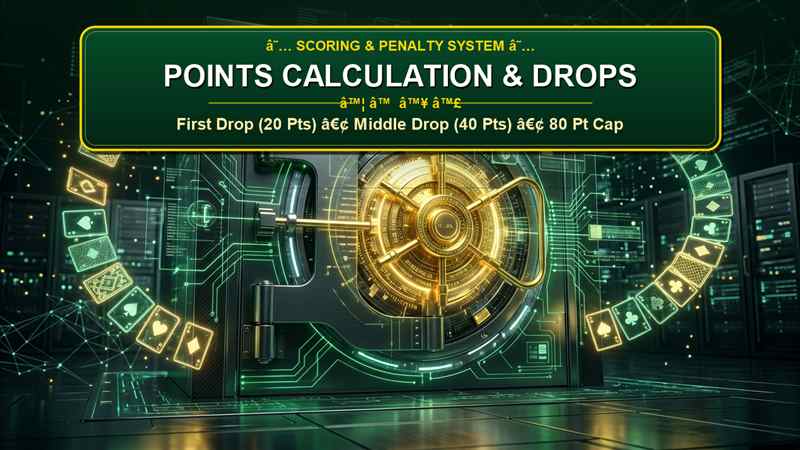
Face cards (King, Queen, Jack) and Aces carry 10 penalty points each. Number cards carry points equal to their printed face value (2 to 10). Jokers carry zero penalty points.
Rule 7: Declaration Protocol and Discard Slot
Once all 13 cards are arranged into valid sequences and sets, slide the 14th card into the designated “Finish Slot” and press Declare. A valid declaration earns 0 penalty points, granting victory.
Valid Melds and Scoring Valuation Matrix
Study this reference matrix detailing combination types and point rules in Rummy Card Rules:
Pure Sequence vs Impure Sequence vs Valid Sets
Understanding the functional distinction between combinations is vital when evaluating table moves during live cash matches. A pure sequence cannot contain any wildcard substitution unless a cut joker naturally belongs to that suit and rank (e.g., 3♦-4♦-5♦ where 4♦ is the cut joker).
In contrast, impure sequences welcome both printed and wild jokers to bridge gaps. For instance, in 10♣-PJ-Q♣, the printed joker serves as the Jack of Clubs.
Read up on advanced tournament tactics in our latest articles on the Boss Rummy Blog.
Printed vs Cut Wild Jokers in Play
Two distinct joker formats exist in competitive play: printed jokers (bearing graphic illustration) and cut wildcards. At the start of each round, a card pulled from the closed deck establishes the cut joker.
If the cut card is an 8 of Diamonds, all four 8s (8♦, 8♠, 8♥, 8♣) act as wild jokers for that entire round. If the cut card happens to be a printed joker, then Aces across all four suits function as wild jokers.
Review privacy protocols and data encryption standards on the Boss Rummy Privacy Policy.
Legal Declarations and Wrong Show Penalties
Submitting an invalid declaration under Rummy Card Rules is one of the most costly blunders in competitive card gaming. If you declare without at least one pure sequence and one secondary sequence, your hand receives the maximum 80 penalty points immediately.
Always consult our safe play guidelines on Responsible Gaming to maintain disciplined bankroll control.
Frequently Asked Questions: Rummy Card Rules
Can a valid set have more than 4 cards?
No. A set can contain a maximum of 4 cards (one from each suit: Spades, Hearts, Diamonds, Clubs), or 3 unique suit cards plus one wild joker.
Can I declare a hand consisting entirely of four sequences?
Yes. Sets are optional in Rummy Card Rules, but sequences are mandatory. As long as you have at least one pure sequence and one secondary sequence, having 3 or 4 sequences is entirely legal.
What points do wild jokers carry if caught in an unarranged hand?
Both printed jokers and wild cut jokers carry 0 points when left in your hand, meaning they never contribute to your penalty score if an opponent declares first.
Where can I get clarification on table dispute rulings?
Our support team is available 24/7 to resolve table questions via our official Boss Rummy Contact Us helpdesk.
Master Rummy Card Rules on Boss Rummy
Apply your understanding of Rummy Card Rules in real-time matches on India’s most dependable card gaming destination:
- Verified APK Direct Link: Boss Rummy App Download
- Platform Capabilities & Shuffling: Boss Rummy Features
- Beginner Step-by-Step Tutorial: How to Play Boss Rummy
- About the Platform & Heritage: Boss Rummy About Us
- Official Home Portal: AllBossRummy
Download the verified application today to master card combinations and claim your exclusive welcome chips!
You May Also Check: Yono Bingo 101
You May Also Check: INR Rummy
You May Also Check: New Gold Rummy
You May Also Check: MX Rummy App
You May Also Check: What Is Ever 777 Game?